
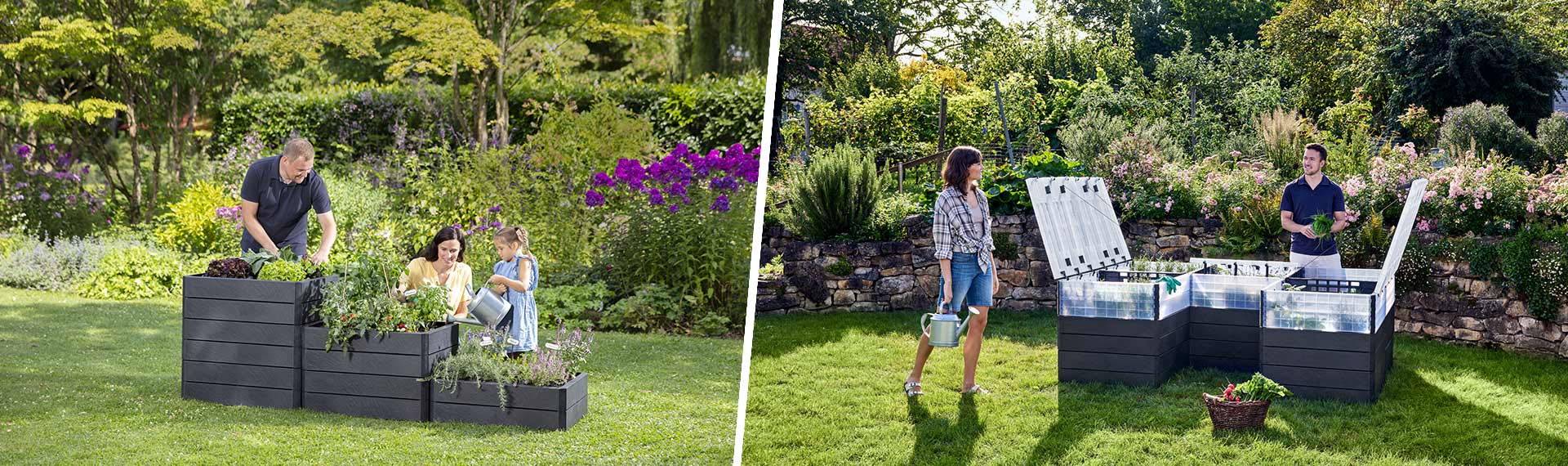
Raised beds for every garden
Our raised beds offer the perfect solution for anyone who wants to garden in a back-friendly way while enjoying a bountiful harvest. Thanks to their well-thought-out design and high-quality materials, they ensure optimal growing conditions and a long service life. Whether in the garden, on the patio or on the balcony, we have a variety of raised beds for every location and need. Discover our selection and find the right raised bed for your green project!
Our new product – the Skyline raised bed
Our stylish raised bed in a modern design – an eye-catcher in any garden. With its simple click fasteners, it can be set up in just a few minutes.
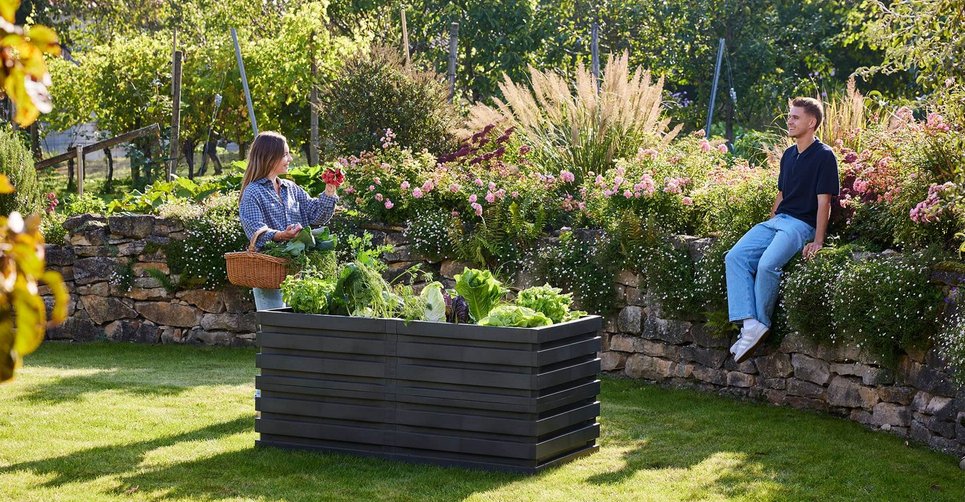
The Ergo family – the right raised bed for everyone
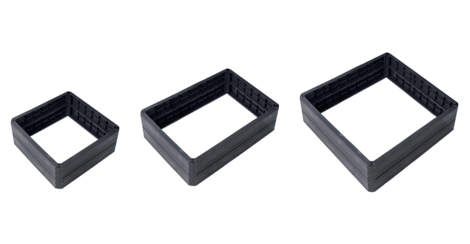
There is something for everyone in our Ergo family. A system in which you can choose from different variants and combine them with each other. Starting with our classic raised bed to the TurboPlus raised bed, which allows you to enjoy an even longer gardening season. Ergo raised beds are available in a practical hexagonal shape, but also in a space-saving rectangular shape, both in our popular wood finish and in a modern stone finish.
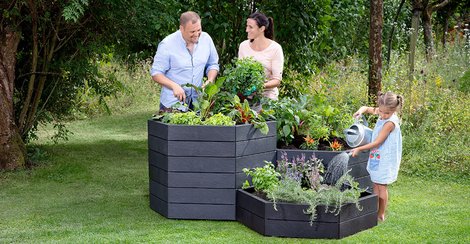
Urban raised bed – for balconies and patios
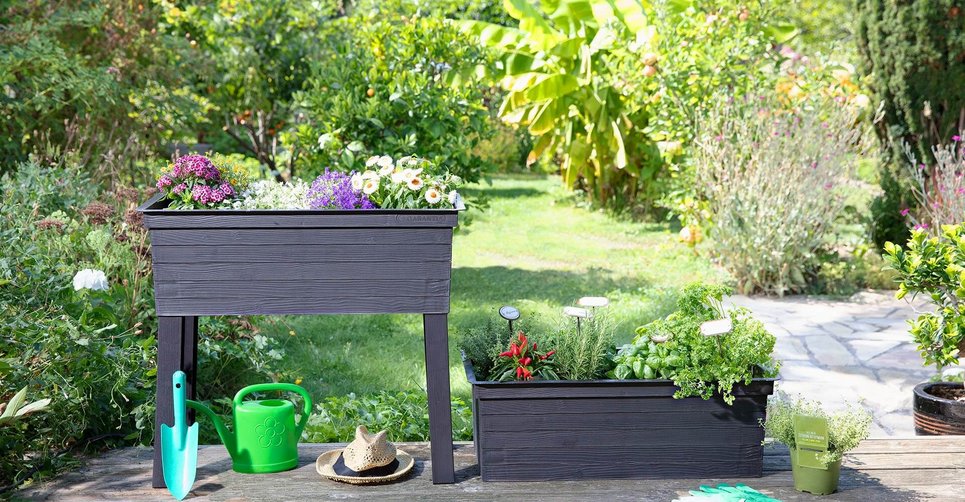
Don't have a garden or don't need much space for your raised bed? Then our Urban is perfect for you. It is easy to transport from one location to another and does not require much space. In winter, you can easily remove the legs and store it in your garage, basement or conservatory to save even more space. A small all-rounder that impresses!
Further information on raised beds
Discover more information to make your gardening year even more successful with a raised bed. Learn more about how to fill your raised bed correctly and the best time to do so, which layers are best suited for a raised bed, and tips and tricks for the entire raised bed year.


The most important questions about raised beds
-
What is the most suitable material for a raised vegetable patch?
Plastic is particularly well suited to raised beds: it is low-maintenance, frost-resistant, durable and requires no chemical treatment. Unlike wood, plastic does not rot, warp or need painting. With wood, there is also a risk that harmful substances from chemically treated materials may leach into the soil. Metal, stone or Ytong are also options, though they are significantly more expensive, more difficult to assemble and tend to heat up in summer.
-
What should be the minimum depth of a raised vegetable bed?
A raised bed should be at least 25 cm deep; this is sufficient for lettuce or herbs. For tomatoes, courgettes or carrots, a depth of 50 to 75 cm is recommended. Many raised bed systems are modular; individual modules can be easily stacked on top of one another and thus customised to the desired depth and choice of plants.
-
Do I need a sheet or an interior lining?
Plastic raised beds do not require any plastic sheeting or internal lining, as plastic is naturally moisture-resistant. Wooden raised beds, on the other hand, require an internal lining, such as dimpled membrane, to protect the wood from moisture. Pond liner is unsuitable, as it causes condensation to form and allows the wood to rot from the inside. Never use plastic sheeting at the base, so that water can drain away.
-
What type of soil is best suited to a raised vegetable patch?
A level, firm surface with natural drainage – such as natural soil, lawn or paving with joints – is best. This allows soil organisms to migrate into the raised bed and allows excess water to drain away. On sealed surfaces such as concrete or patios, it is essential to include a drainage layer to prevent water from pooling.
-
Can I set up a raised vegetable patch directly on the lawn?
Yes, that’s perfectly possible. Mow the lawn briefly beforehand; there’s no need to remove the turf – it will rot and provide additional nutrients. Alternatively, it can be turned over and used as the bottom layer of mulch. To protect against voles, we recommend laying a fine-mesh wire mesh under the bed.
-
What layers should a raised vegetable patch have?
A raised bed is built up in four layers from the bottom upwards: first, about 20 cm of coarse branches and twigs; on top of that, about 15 cm of leaves, grass clippings or straw; then about 10 cm of semi-mature compost; and, at the very top, 20 to 30 cm of high-quality potting soil. It is important to always layer from coarse to fine so that the flow of water is not obstructed.
-
Can you fill a raised vegetable bed with just soil?
Yes, that is possible, but not recommended. Plain soil compacts quickly, settles and provides fewer nutrients than a traditional layered structure. If you do choose to use only soil, you should opt for high-quality raised-bed compost rather than ordinary garden soil. Without a layered structure, the greatest advantage of a raised bed is lost: the natural heat generated by decomposition.
-
Do I need to install a drainage system?
If the layers are laid up correctly, drainage is not necessary, as the bottom layer of coarse branches and twigs automatically acts as a drainage layer. On sealed surfaces such as concrete or a balcony, an additional drainage layer of expanded clay is advisable to prevent water from pooling and the roots from dying. Expanded clay is better than gravel, as gravel retains cold.
-
In which month is it best to plant in a raised bed?
You can plant a raised bed from March onwards with hardy crops such as lettuce, spinach or radishes; with a fleece cover, you can even start a little earlier. Heat-loving plants such as tomatoes or courgettes should only be planted after the ‘Ice Saints’ in mid-May. Lamb’s lettuce, a typical autumn and winter crop, can be sown from August onwards and can even withstand light frost in the bed. This means the raised bed can be used almost all year round.
-
Which vegetables are particularly suitable for a raised bed?
Tomatoes, courgettes, peppers, lettuce, radishes, Swiss chard and herbs thrive particularly well. In the first year, heavy feeders in particular benefit from the nutrient-rich layers; after that, it is advisable to switch to medium and light feeders. Plants that require a lot of space, such as pumpkins or maize, are less suitable as they take up too much space. Flowers such as marigolds or nasturtiums can also be grown alongside them and help keep pests at bay.
-
Which plants should not be planted together in a raised bed?
Fennel should not be planted in the same raised bed as other vegetable plants, onions and beans, or tomatoes and cucumbers, as they require different levels of moisture. Fennel inhibits the growth of almost all types of vegetables and should be planted separately. Never grow brassicas in the same spot for several years, as this encourages disease. Planting too densely also encourages powdery mildew.
-
What should I do with my raised vegetable patch in winter?
In winter, you should cover the raised bed and not leave it empty. Remove any leftover produce and cover the surface with mulch, leaves or green manure. Never leave the bed empty and uncovered, as this will cause nutrients to be washed away. Winter vegetables such as lamb’s lettuce or kale can be left in the bed. Water occasionally on frost-free days; soil life needs some moisture even in winter.
-
How can I protect my raised vegetable bed from field mice and snails?
Raised beds can be protected from voles by placing a fine-mesh wire mesh at the base, and from snails by fitting a snail barrier around the edge of the bed. The wire mesh should have a maximum mesh size of 13 mm and should be fitted during construction; retrofitting it is virtually impossible. Another way to deter snails is to water in the morning rather than in the evening, as dry surfaces keep snails away. Do not apply a layer of mulch directly at the edge.